
DuPage County Court Records After a Jail Arrest
A DuPage County jail arrest and the later court record are related, but they are not the same file. The Sheriff's Office Corrections Bureau records the booking at the DuPage County Correctional Facility in Wheaton. After that, the DuPage County State's Attorney reviews the law-enforcement submission and decides what charges to file or decline. If a criminal case is filed, the Circuit Court Clerk maintains the public case record for the 18th Judicial Circuit Court.
The booking side can show custody details, arresting agency information, booking identifiers, and jail-related charge text. The court side tracks the prosecutor's filed charges, docket entries, court dates, balances due, and case status. For custody and booking fields, use jail inmate records. For booking-photo access, use jail mugshots. This court-records-after-arrest page focuses on the formal charge record that follows the arrest.
How to Find DuPage County Court Records After an Arrest
The public court path starts with the DuPage Circuit Court Clerk and the Circuit Court Clerk Public Information Application. The Clerk's landing page lists public services for paying traffic tickets, paying civil law violations, paying all or part of a case balance, changing an address on a case, and searching for a case to review case status, next court date, docket entries, or traffic-case email updates. During research, the public search entry was protected by a Turnstile challenge, so the post-challenge search form could not be inspected directly.
- Open the DuPage Circuit Court Clerk site or the public case lookup and payment landing page.
- Choose the public option labeled "Search for your Case" and complete any required anti-automation check.
- Search by the available case identifier or party information shown by the Clerk system after the challenge.
- Open the case result and compare the charge list, docket entries, next court date, case status, and any balance or payment information.
Use the court portal for filed cases, not as a substitute for the jail roster. A person can appear on the jail roster before the court record is fully visible, and a released person can still have a pending court case. For older, sealed, impounded, juvenile, or expunged records, the online public search may not be enough. The Circuit Clerk's office at 505 N. County Farm Road in Wheaton and the Criminal/Traffic phone line at 630-407-8600 are the documented access channels for criminal and traffic case questions.
The official Circuit Court Clerk Public Information Application is the matching public lookup source for DuPage County court cases, and the direct public search entry is documented at allsearch.do.
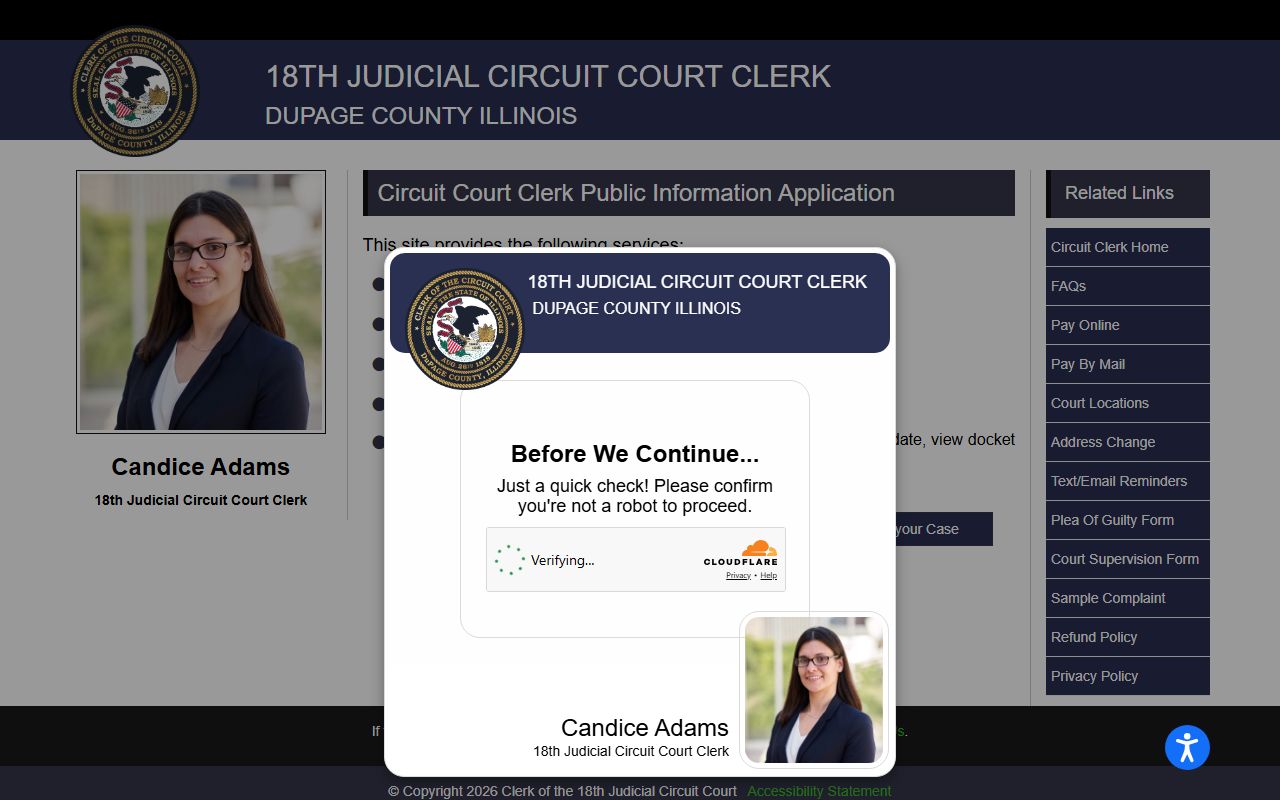
The landing page image fits this section because it shows the public route a user reaches before searching for the case status, next court date, docket entries, or payment information connected to a filed court case.
| Field or Access Point | Type | Required | Notes |
|---|---|---|---|
| Search for your Case | Button or link | Not applicable | Public landing-page option that routes to the case-search entry. |
| Case Number | Known case lookup function | Unspecified | Research found a hidden caseNumber form element and confirmed public case lookup support. |
| Turnstile check | Anti-automation challenge | Required to proceed | The public search page displayed a "Before We Continue" verification during research. |
| eAccess User ID | Text login field | Yes for restricted access | Restricted CRIS/eAccess account field, max length 20 in the captured HTML. |
| eAccess Password | Password field | Yes for restricted access | Restricted CRIS/eAccess password field, max length 25 in the captured HTML. |
| Request Access | Link or button | Not applicable | Attorneys, policing agencies, and approved self-represented litigants may request access. |
How Charges Get Filed After an Arrest: Complaint, Information, and Indictment
At booking, the roster may show an arrest charge or a law-enforcement description tied to the custody event. The court record begins when the case is filed in the court system. In DuPage County, the State's Attorney is the local prosecutor. Bob Berlin has served as DuPage County State's Attorney since December 14, 2010, and the office reviews police reports and evidence before filing or declining charges.
A complaint, information, or indictment can all start or frame the criminal case, but they come from different parts of the process. A complaint is a charging document that may begin a criminal case. An information is a prosecutor-filed formal charging document used in many criminal matters. An indictment comes from a grand jury in qualifying felony matters. Because the prosecutor can amend, reduce, add, or dismiss counts after booking, the charge list in court can differ from the initial jail record.
| Complaint | Information | Indictment | |
|---|---|---|---|
| Filed By | Often initiated through law enforcement and prosecutor review | Prosecutor | Grand jury |
| Common For | Cases that begin from an arrest or sworn allegation | Many felony and misdemeanor prosecutions | Qualifying felony matters |
| Starts | The court case or an early charging stage | The formal prosecutor-filed charge record | The formal grand-jury charge record |
| Reader Caution | May not match the final charge set | May be amended later | Can replace or reshape earlier charges |
Charge Status in Court Records After an Arrest
Charge status is the part of the court record that shows whether an allegation is still pending, has changed, or has ended. A DuPage County jail roster entry can list booking charges, court date fields, charge descriptions, case number fields, and bond fields in the official roster model. The Circuit Clerk record is the better place to verify the filed charge, current court date, docket activity, and final disposition. For the same arrest, one count may remain pending while another is dismissed, amended, or reduced.
| Status | What It Means |
|---|---|
| Pending | The charge is still active in court and has not reached a final disposition. |
| Amended / Reduced | The prosecutor or court record reflects a changed charge, level, count, or description after the original filing. |
| Dismissed | The court record shows that a charge or count was ended without a conviction on that count. |
| Nolle Prosequi | The prosecution has declined to continue a charge, a term often reflected as a dismissal or dropped prosecution in court records. |
| Convicted / Guilty | The case reached a conviction through plea, finding, or verdict on that charge or count. |
Bond and Release After an Arrest
Release information after a DuPage County arrest must be read with Illinois pretrial reform in mind. Illinois no longer uses money bond in the same way for new pretrial release decisions. Under 725 ILCS 5/110-2 and 725 ILCS 5/110-6.1, pretrial release is presumed unless the State files a detention petition and the judge makes required findings under the eligible-offense and risk standards. That means a payment amount alone does not always answer whether someone can leave custody.
The sheriff's bond and surrender instructions still matter for older cases, warrant-related bonds, court-ordered payments, and surrender processing. The DuPage sheriff states that bond may be posted at the correctional facility 24 hours a day, every day of the year, when the Sheriff's Office can accept it. Accepted payment forms include exact cash, certified check, cashier's check, money order, or full-amount credit-card payment made in person. A $30 bail bond processing fee is assessed for each bail bond processed by the Sheriff's Office, and credit-card payments carry third-party processing fees.
| Release or Payment Term | How It Works in DuPage County Context |
|---|---|
| Cash Bond | Where accepted by the sheriff, payment must be the exact cash amount plus the required processing fee. |
| Certified / Cashier's Check or Money Order | These must be payable to "DuPage County Sheriff Inmate Accounts," not to the incarcerated person. |
| Credit Card | The card payment must cover the full total in person at the facility, and the payer needs photo ID matching the card. |
| Pretrial Release | For current Illinois cases, the judge applies statutory release or detention standards rather than treating cash bail as the default answer. |
| No-Bond Hold / Detention Hold | A detention order, another agency hold, detainer, warrant, probation or parole issue, immigration matter, or state-prison hold may prevent release by payment alone. |
Warrants That Lead to an Arrest
A warrant can be the reason a person is booked into the DuPage County Correctional Facility, but the jail roster is not a complete warrant-search system. The Sheriff's Office has an official Warrants Division page, yet research did not confirm a public searchable warrant list for DuPage County. Warrant-related court records may appear through the Circuit Clerk when a case is open, and the JailTracker model includes a warrant-number field when applicable.
For warrant-related custody questions, documented channels include the sheriff main line at 630-682-7256, Booking and Bond or Receiving and Discharge at 630-407-2255, the Circuit Clerk Criminal/Traffic phone line at 630-407-8600, and in-person court or clerk inquiry at 505 N. County Farm Road in Wheaton. A person surrendering on a warrant may do so at the correctional facility at any time, should report to Receiving and Discharge, use the entrance marked "JAIL ENTRANCE," and bring photo ID if available. Personal belongings other than ID and cash are held in property control until release.
Charges vs. Convictions
An arrest followed by a filed charge is an accusation, not a conviction. This distinction matters when reading DuPage County court records after a jail arrest. The case may be pending, the prosecutor may change the charge, or the court may dismiss a count before any finding of guilt. A conviction exists only after a guilty plea, finding, or verdict and any related court disposition.
| Charge | Conviction | |
|---|---|---|
| Stage | Accusation filed or listed in a case | Final adjudication by plea, finding, or verdict |
| Meaning | The person is alleged to have committed an offense | The court has entered a guilty outcome on that offense or count |
| Public Record | Often public while active, unless sealed, juvenile, impounded, expunged, or exempt | Often public unless later sealed, expunged, impounded, or otherwise restricted |
| Why It Changes | May be amended, reduced, dismissed, or replaced | May later be affected by appeal, sealing, expungement, or other court order |
Sealed vs. Expunged Arrest Records
Illinois law separates sealing from expungement. Under 20 ILCS 2630/5.2, eligible criminal-record expungement and sealing petitions are generally filed through the clerk where the arrest or charge occurred. The DuPage Circuit Clerk eAccess notice also matters because its restricted system states that inactive, impounded, sealed, expunged, and juvenile-first-named-defendant cases are not included in that access channel.
Sealing usually limits public access while preserving the record for certain official purposes. Expungement is a stronger remedy for eligible records and is commonly described as treating the record as removed from public access through the legal process. Eligibility depends on the disposition, offense type, timing, prior record, and court orders. A dismissal does not automatically remove every public trace; the clearing step usually requires a petition and court action.
| Sealed | Expunged | |
|---|---|---|
| Public Visibility | Hidden from ordinary public access if the court grants sealing | Removed from ordinary public access if the court grants expungement |
| Official Access | Some agencies may retain limited access under Illinois law | Access is more limited and controlled by the expungement order and statute |
| Eligibility | Depends on Illinois law, offense type, disposition, timing, and court review | Depends on Illinois law, offense type, disposition, timing, and court review |
| Where Filed | Generally through the clerk where the arrest or charge occurred | Generally through the clerk where the arrest or charge occurred |
Background Check Considerations
Casual court lookup and a compliant background check are different uses. Public court search can help a reader identify a case number, filed charges, docket status, and next court date, but it should not be treated as a consumer report. Employers, landlords, insurers, lenders, and other regulated users must follow the Fair Credit Reporting Act and any state-law requirements that apply to their screening purpose.
Important: This website is not a consumer reporting agency and cannot be used for FCRA-covered screening decisions.
Restricted Court Records After an Arrest in DuPage County
Illinois public access is broad, but not unlimited. FOIA requires public bodies to make non-exempt public records available for inspection or copying, and 5 ILCS 140/2.15 requires certain arrest-report information to be furnished as soon as practical and no later than 72 hours after arrest, subject to exceptions. Law-enforcement records may be withheld or redacted under 5 ILCS 140/7(1)(d) when disclosure would interfere with proceedings, endanger safety, reveal confidential sources or techniques, or obstruct an investigation.
Juvenile, sealed, expunged, impounded, inactive, and active-investigation materials require careful routing. The public Clerk portal may not show them, CRIS/eAccess excludes several restricted categories, and some records may require party access, attorney access, a court order, an in-person clerk process, or may be unavailable to the public. For case-specific restrictions, use the Circuit Clerk, the court, or legal counsel rather than assuming that a missing online record means no arrest or no case exists.